Back-to-School Trash: Why Your Bin Smells Different in September
August 25, 2026 · Bin Bros KC Team
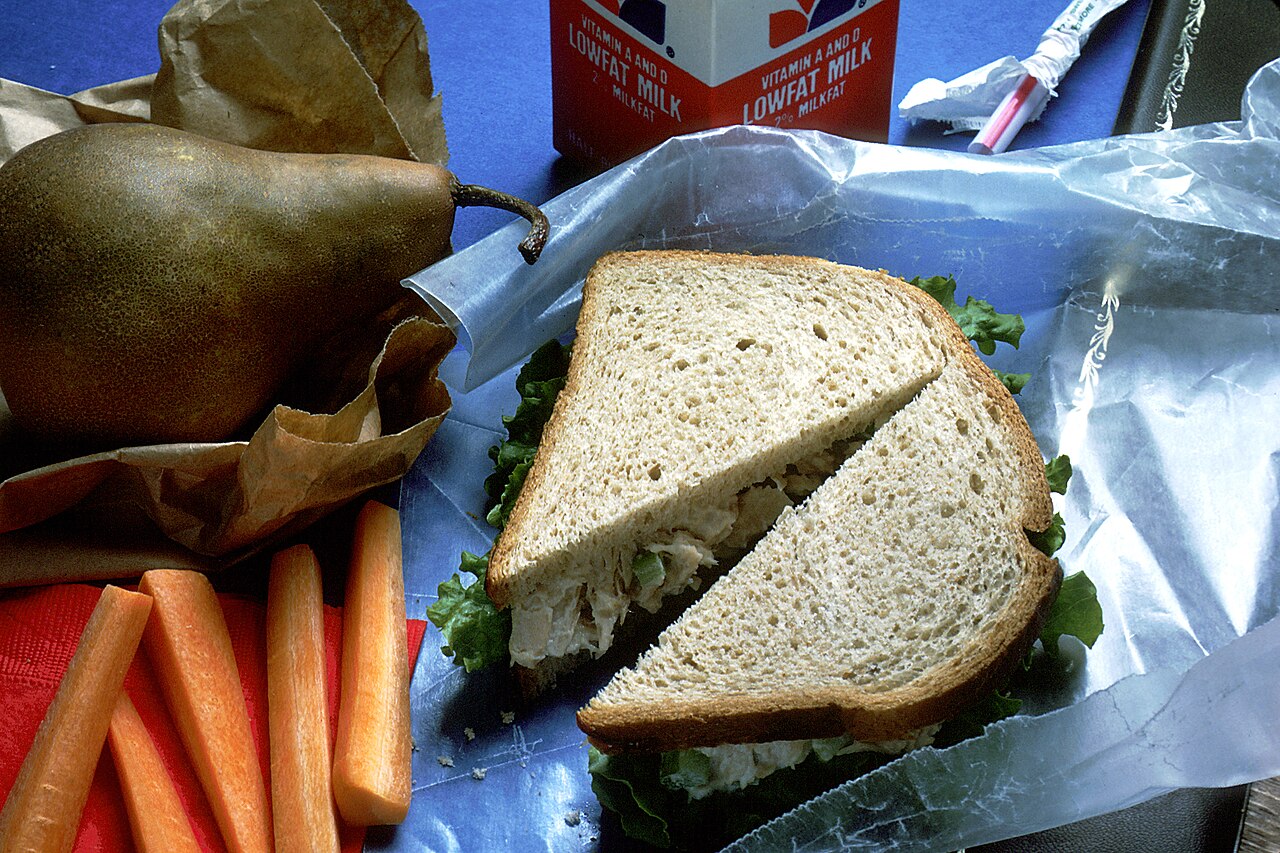
Brown bag lunch with sandwich, carrots, pear, and milk carton, National Cancer Institute via Wikimedia Commons, Public domain

The first day of school in North Kansas City and Liberty was Tuesday, August 25. By that Friday afternoon, the kitchen trash in a few thousand Northland houses had picked up a new weekly rhythm. By the following Tuesday, so had the cart at the curb.
Nobody plans for this part. The supply list gets bought, the bus route gets checked, the first-day photo gets taken on the driveway. Then a lunchbox comes home Friday with most of a sandwich still in it, and that sandwich has been riding around in a backpack since 7:15 that morning.
Week-old milk carton funk coming off your cart? Let the Bros clean it.
200°F water. No soap, no chemicals, pet-safe. We come to your curb and haul the funk away.
Book in 60 seconds — 50% off with FIRST50 →What actually changes in your trash when school starts
Summer trash is erratic. Some weeks a household of four barely fills the cart. Then there is a cookout and it is full by Wednesday.
School trash is metronomic. Five days a week, at close to the same hour, the same category of waste lands in the same can: food nobody ate, after six to eight hours at whatever temperature the day happened to be, wrapped in something that holds moisture against it.
Three things show up with it.
- The uneaten half of a packed lunch. Crusts, the fruit that got traded and came back, a yogurt with two spoonfuls gone.
- Snack packaging with product still inside. Squeeze pouches with an ounce left, a juice box that got abandoned at recess, a granola bar with one bite taken out of it.
- The Friday backpack excavation. Whatever migrated to the bottom of the bag over five days and got found on Sunday night.
None of it is much by weight. All of it is wet, sugary, and warm when it goes in.
The lunchbox is the problem, not the cafeteria
Cafeteria waste is real, and the numbers are worse than most parents guess. A cross-country comparison covered by Penn State found that 27% to 53% of the food served in an American school cafeteria gets thrown away, against 23% in Sweden and 30% in Spain.
None of that reaches your curb. It goes in the district's dumpster.
The waste that reaches your curb is the packed-lunch version, and it has one feature cafeteria waste does not: it rides home in an insulated bag first.
Why the timing matters more than the amount
USDA's rule for perishable food is two hours at room temperature, one hour once the air is above 90°F. The Danger Zone runs 40°F to 140°F, and bacteria inside that window can double roughly every twenty minutes.
A lunch packed at 7:00 a.m. and eaten at 11:45 has already spent most of that budget. The half that does not get eaten keeps going: through afternoon classes, onto the bus, into a backpack by the door until somebody unpacks it.
That chicken salad has been culturing for nine hours before it ever touches your kitchen can. Then it goes to the garage or the driveway for another seven days.
The milk carton is the single worst item
Half-finished milk is the one thing our crew can name by smell before the lid is all the way open.
Milk protein breaking down throws off the same nitrogen compounds behind the ammonia bite in a neglected cart, which we broke down in why trash cans smell like ammonia. A carton that is a third full and lying on its side drains out over three or four days, straight into the scuffs on the cart floor. A hose cannot reach into a scratch. That is the whole reason the smell survives a rinse.
The same goes for a squeeze pouch with an ounce left in it, and for the last two inches of a juice box.
September in the Northland is still summer
This is the part that catches people. School starting reads as fall, so the cart gets treated like a fall cart. The weather has not signed off on that yet.
National Weather Service normals for Kansas City put the September 1 high at 84°F, and it does not fall to 74°F until the final days of the month. The first three weeks of the school year run at close to July conditions inside a closed 96-gallon container.
Flies have not quit either. A cart on a driveway off NE Barry Road in early September is still a perfectly good place for a housefly to lay eggs, and in that heat the trip from egg to something you can see takes about a day. Prevention is the same playbook we wrote for summer maggot prevention, and it holds through Labor Day and past it.
So the cart that caught a break in late August, when the kids were home and grazing out of the pantry, goes right back on the clock the week school starts.
The back-to-school purge nobody plans for
There is a second wave, and it lands the weekend before day one or the weekend after.
Last year's backpack. A lunchbox with a broken zipper. Binders, dried-out markers, a graphing calculator that will not power on, shoes that stopped fitting in June.
Most of that belongs in the cart. Two categories do not.
- Batteries. That includes the cells in the dead calculator and any lithium battery out of broken headphones or a tablet. Crushed in a collection truck, they start fires.
- Electronics. Old tablets, chargers, a cracked Chromebook the district replaced.
We listed where those actually go in what not to put in your residential trash. The short version: regional household hazardous waste collection takes both, and it takes about ten minutes to drop them off.
How do you get the smell out of a lunch box?
The lunchbox sits upstream of the cart. Fix it there and the cart gets easier.
- Unpack it the same day, every day. A lunchbox that skips Friday and gets opened Sunday night is a different problem than one opened at 4 p.m. Make the rule that the box goes in the sink, not back in the backpack.
- Wash the liner, not just the containers. Most insulated liners are foam behind a wipeable film, and the seams at the corners hold liquid. Warm water and a cloth along every seam beats a spray on the flat panels.
- Dry it open. A zipped damp lunchbox in a warm kitchen is the same setup that grows film inside a trash cart. If you are seeing gray haze or dark spots in the corners, that is the mold and mildew problem at small scale.
- Freeze five ice packs on Sunday. Running out on Thursday is how the warm-lunch cycle restarts, and it is the failure point in almost every household that has this sorted otherwise.
What keeps the cart livable through the school year
- Bag the wet stuff separately and tie it. A grocery sack knotted around the day's lunch scraps costs nothing and stops the drain-hole pooling.
- Freeze the worst offenders until trash morning. Milk cartons, meat trimmings, anything that leaked. A gallon bag in the freezer beats four days in an 84°F cart.
- Take the cart out the night before, not two nights before. Pickup on a Gladstone street off N Oak Trafficway does not care whether the cart sat out Sunday.
- Clean the day after pickup, when it is empty. Twenty minutes on an empty cart, or an hour of fighting a half-full one.
- Set the cadence on the calendar instead of on the smell. Odor lags the problem by weeks. Quarterly covers most Northland households, tightening to every four to six weeks in August and September, which is the math we ran in how often bins need cleaning.
That day-after-pickup timing only helps if you know which day your street runs. The trash day map has pickup for every Northland ZIP, from Liberty 64068 to Kearney 64060 to Parkville 64152.
What to do this week
- Open the cart and look at the floor of it, not the top. Everything from the last two weeks of summer is still down there, and September heat is about to work on it.
- Set the lunchbox rule tonight. Sink, not backpack. It takes one week to stick and it removes the upstream half of this entirely.
- Pull the batteries and electronics out of the purge pile before the cart goes out. Household hazardous waste takes them, the truck should not.
- Book the deep clean for the week after Labor Day, which is when the summer buildup and the first three weeks of lunch scraps have finished combining. First clean is $37.50 with code
FIRST50, half off the $75 one-time rate — or quarterly service runs $15 a month ($22.50 first clean with the same code). Sign up here. We work at the curb, so nobody needs to be home and nobody needs to answer the door.
Week-old milk carton funk coming off your cart? Let the Bros clean it.
200°F water. No chemicals. Pet-safe. No contracts. Code FIRST50 takes 50% off your first clean.