Trash Can Mold vs. Mildew: How to Tell, What Kills It
August 18, 2026 · Bin Bros KC Team
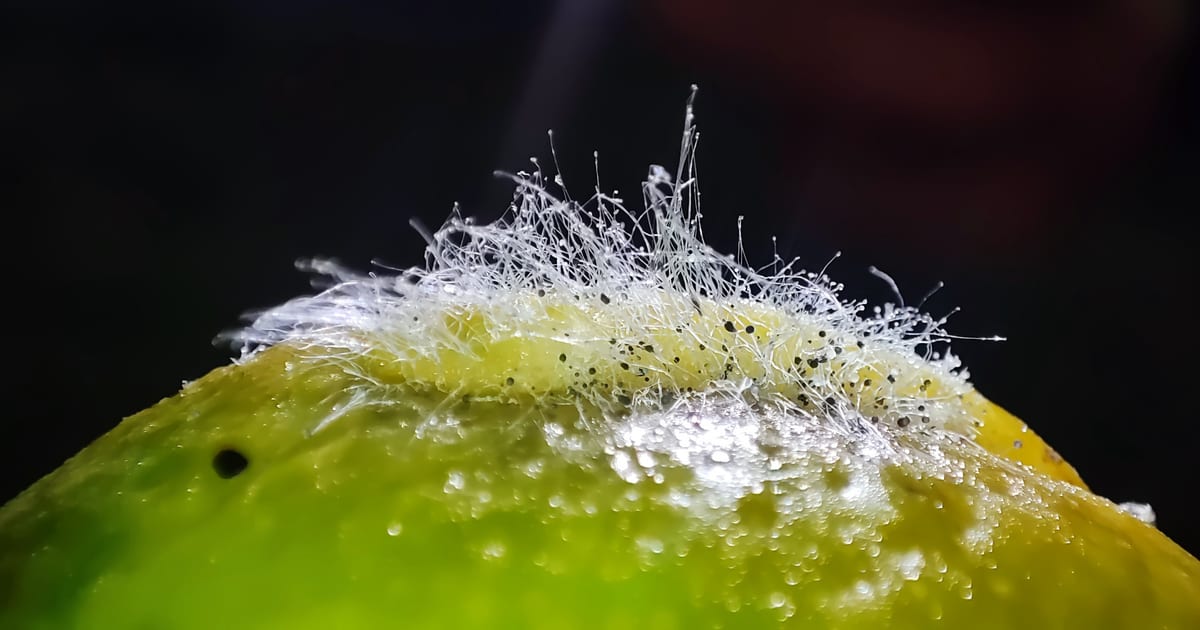
Fungal mold growing on the surface of a lemon by Ali Alaswad, Wikimedia Commons, CC BY-SA 4.0

A customer in Shoal Creek sent us a photo in early August: the inside of a recycling cart, lid propped up, a gray haze across the bottom third and one dark patch near the drain hole that clearly did not match. Her question was two words long.
"Mold, right?"
Half right. The wrong half is the one that decides how much work the cart actually needs.
The gray haze and the dark patch are not the same problem at two different sizes. They are the same organism at two different stages, and there is a ten-second test that tells you which one you are looking at while you are still standing there with the lid open.
Black fuzz creeping up the inside of your cart? Let the Bros clean it.
200°F water. No soap, no chemicals, pet-safe. We come to your curb and haul the funk away.
Book in 60 seconds — 50% off with FIRST50 →Is mildew the same thing as mold?
Close enough that the distinction people argue about online is mostly wrong, and different enough that it is worth getting right.
University of Missouri Extension puts it plainly. Mildew is "a thin, black, or sometimes white, growth produced by mold". Mildew is not a rival organism competing with mold for space in your cart. It is what mold looks like early, while it is still living on the surface rather than down in it.
So the useful question is not "mold or mildew." It is "how far along is this," and the answer changes what you do on Saturday.
How to tell mold from mildew in a trash can
Texture, color, and one dry paper towel.
Mildew: flat, powdery, gray or white
Mildew lies flat. Drag a finger across it and the plastic underneath still feels smooth. The color runs gray, white, or a dusty light brown, and it spreads outward as a haze instead of upward in clumps. The smell is musty in the way a closed-up cabin is musty.
Mold: raised, fuzzy, and colored
Mold has height. You can see the texture from three feet away, sometimes fine and hairlike, sometimes clumped like velvet. The color goes darker and more saturated: black, green, blue-green, occasionally orange or pink right at the drain hole where liquid pools and sits. The smell is heavier and more like dirt than like a closet.
The paper towel test
Wipe a two-inch patch with a dry paper towel.
- It lifts and the plastic underneath looks clean. Surface mildew. A hot rinse and a dry afternoon handle it.
- It smears, or it lifts but the shadow stays put. The growth is down in the scratches. Every cart older than a season has a scuffed interior, and those scuffs are exactly where colonies anchor. This one needs heat.
- The towel comes away wet and slick. That is biofilm rather than either of them, and it is a different fight. We covered what that film is made of in bacteria buildup in trash cans.
Why August turns Northland mildew into mold
A trash cart in August is a purpose-built incubator, and that is not a figure of speech.
The MU Extension guidance says the molds that cause mildew "flourish wherever it is damp, warm, poorly lighted and/or where air is not circulated." Read that back as a description of a 96-gallon cart sitting in a driveway with the lid shut. Damp, warm, dark, no airflow. Four for four.
Then add the local numbers. National Weather Service normals put early-August highs in Kansas City near 89°F, and the EPA's guidance is that wet material has to be dried within 24 to 48 hours to prevent mold growth. A cart on a Gladstone driveway off N Oak Trafficway holds its trash for seven days, not two. Something leaks on Tuesday, and by Thursday the clock the EPA is describing has already run out twice.
The food source is the easy part to supply. Extension again: "soil on dirty articles can supply enough food for mildew to start growing." A smear of yogurt qualifies. So does the juice at the bottom of a bag that split on the way out.
Is mold in a trash can dangerous?
For a healthy adult, an outdoor cart is a nuisance rather than a hazard. You do not live in it, and the exposure is thirty seconds a week at arm's length.
The exposure that matters is the one you create yourself. Slamming the lid open on a colonized cart on a 90-degree day, or blasting the inside with a hose, lifts spores into the air you are standing in. That is the actual risk event, and wetting things down before you disturb them avoids most of it.
Three groups should hand the job to someone else rather than work around it: anyone on chemotherapy or immunosuppressants, anyone with asthma or COPD, and anyone pregnant. We wrote the pregnancy version of this in what is safe to handle during pregnancy.
Does bleach kill mold in a trash can?
No, and the EPA says so in writing.
Their guidance states that a biocide such as chlorine bleach "is not recommended as a routine practice during mold cleanup". Bleach is mostly water. The water soaks straight into the scratches while the chlorine evaporates off the surface. You end up with a cart that looks bleached, a fresh delivery of moisture into the exact places the colony lives, and regrowth inside a week.
In a trash cart there is a second problem stacked on the first. Bleach meeting the ammonia in decomposing waste produces chloramine gas, which is a real emergency rather than a theoretical one. The chemistry is in the bleach mistake, and it is the piece of advice our crew repeats more than any other.
How do you get mold out of a trash can?
Heat first, dryness second. That is the entire method.
- Do it the day after pickup. An empty cart is a twenty-minute job. A half-full cart is not a job you will finish.
- Wet the interior before you touch it. Warm water, poured or gently sprayed. Wet growth stays where it is; dry growth goes airborne. This is one of two reasons cold pressure washing fails, which we broke down in the pressure washing myth.
- Go hot. Hot water breaks down the film anchoring the colony to the plastic. Cold water relocates it. Anything baked or frozen onto the wall needs the approach in stuck-on residue fixes.
- Scrub with a long-handled brush, lid seams and the underside of the rim included. The rim is where people stop scrubbing, and it is where mildew reliably restarts.
- Dry it upside down in direct sun. Extension's own removal advice comes down to sun and air. Two hours tipped over on a driveway in August beats any spray you can buy.
Our crew runs 200°F water with a pet-safe deodorizer, no soap and no harsh chemicals, because the heat is what does the work and the rest is theater.
How do you keep it from coming back?
- Bag everything, including the small stuff. Loose wet trash is the whole ballgame.
- Give the cart ten minutes of open lid after a hard rain. Trapped water is the input to all of this.
- Get it out of the garage. Warm, enclosed, and no sunlight is the ideal condition for the thing you just removed.
- Stop parking it on the north side of the house, where it sits in shade from morning to night. A Parkville cart off NW 72nd Street that catches afternoon sun stays visibly cleaner than one tucked behind a privacy fence.
- Clean on a schedule instead of on a smell. Odor is a lagging indicator. Quarterly works for most Northland households, tightening to every four to six weeks through July and August, which we laid out in how often bins need cleaning.
Timing the job to the day after pickup only works if you know which day your street runs. The trash day map has pickup for every Northland ZIP, from Liberty 64068 to Kearney 64060 to Parkville 64152.
What to do this week
- Prop the lid and run the paper towel test. Ten seconds tells you whether you have a rinse or a project.
- If it lifts clean, rinse hot and leave the cart upside down in the sun the day after your pickup.
- If the shadow stays, skip the hose and skip the bleach. Cold water and chlorine each make it worse in their own way.
- Book the deep clean if the growth is raised, dark, or climbing past the bottom third. First clean is $37.50 with code
FIRST50, half off the $75 one-time rate — or quarterly service starts at $15 a month. Sign up here. We work at the curb, so nobody needs to be home and nobody needs to open the door.
Black fuzz creeping up the inside of your cart? Let the Bros clean it.
200°F water. No chemicals. Pet-safe. No contracts. Code FIRST50 takes 50% off your first clean.