Why Trash Bin Wheels Break (and How to Fix One Yourself)
September 17, 2026 · Bin Bros KC Team
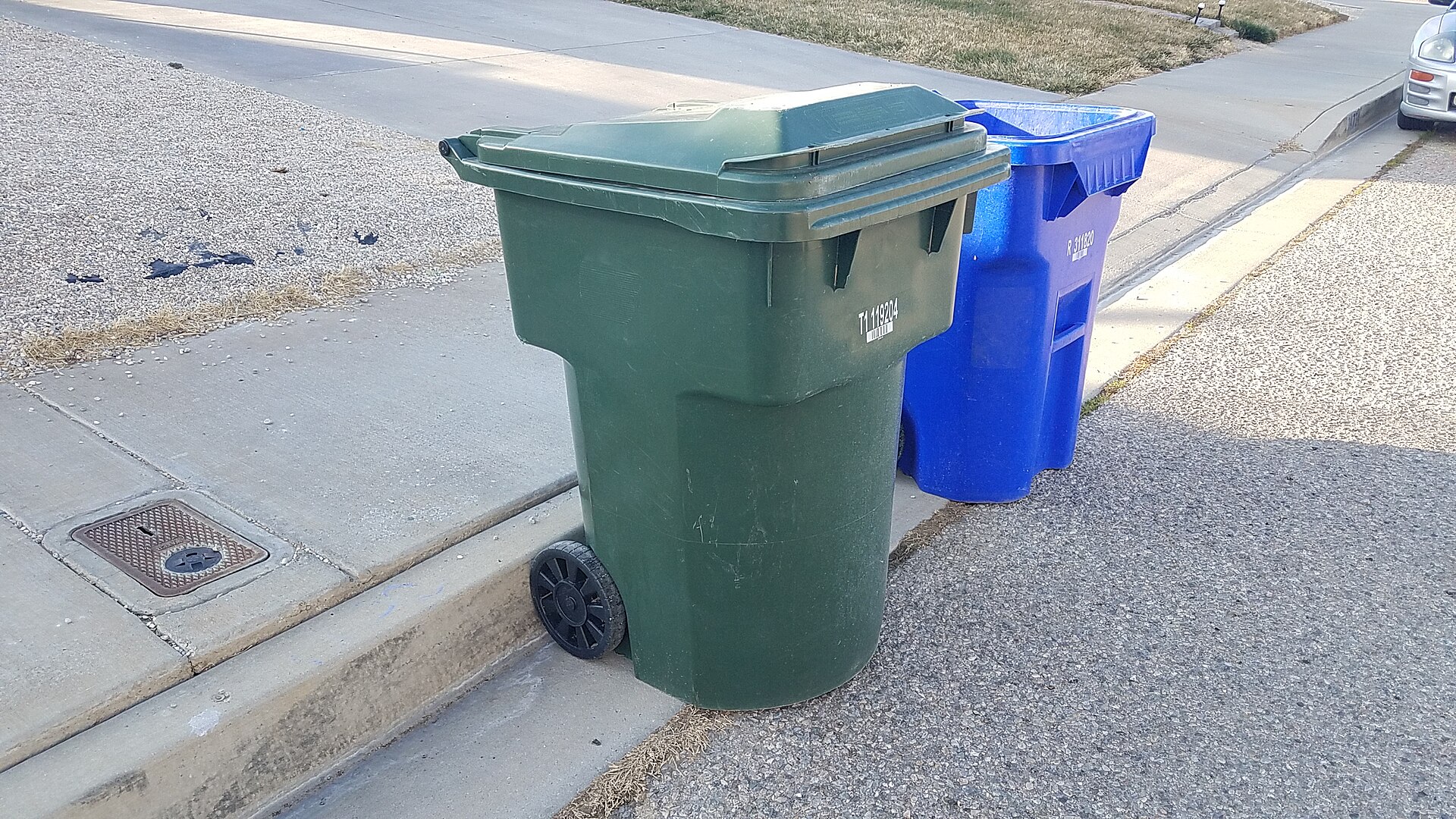
A barcode Rehrig with a staircase lid by TheInvertedFan, Wikimedia Commons, Public domain

A cart wheel almost never fails all at once. It warns you for months first.
There's a faint tick on every rotation on the way down the driveway. The cart leans a little when it sits full at the curb. Then a gray streak shows up on the concrete where one wheel quit turning and started sliding. One Tuesday in January the hub splits, the wheel rolls into the neighbor's yard, and you're dragging a full 96-gallon cart to the street by the handle.
Our crew looks at the wheels on every cart we clean, because the wheel wells are part of the job. Here's what we see break, why it breaks, and what to do about it before your next pickup.
New wheels on a cart that still smells like August? Let the Bros clean it.
200°F water. No soap, no chemicals, pet-safe. We come to your curb and haul the funk away.
Book in 60 seconds — 50% off with FIRST50 →Why do trash can wheels break?
The wheel itself is rarely the problem. The failure is almost always in the hub, the spot where a molded plastic wheel rides on a steel axle. Five things wear that hub out, and most carts get hit by several of them.
1. The axle hole wears into an oval
Toter, one of the largest cart makers in the country, uses a 5/8-inch steel axle in its replacement kits. Every trip to the curb, a plastic hole turns around that steel rod. Grit works its way in: driveway sand, winter road salt, dried garbage juice. That grit acts like sandpaper.
Over a few years the round hole wears oval. An oval hole lets the wheel wobble, and a wobbling wheel puts sideways force on a part designed to take weight straight down. The tick you hear is the wheel knocking against the worn side of its own hub. That's the early warning.
2. Curbs and driveway lips
Carts are built to roll forward on flat ground. They aren't built to be yanked sideways over a curb or dropped off the lip of a sloped driveway apron. The steep driveways around Riss Lake in Parkville (64152) and the hillside streets in Briarcliff (64116) are hard on wheels for exactly this reason.
When a full cart drops off a four-inch lip at an angle, one wheel takes most of the load at one point. Once is nothing. Fifty-two weeks a year for five years is how hubs crack.
3. Too much weight in the cart
Household trash bags are light. Wet grass clippings, a box of broken tile, or a cart that sat open through a rainstorm are not. Heavy, dense loads can bend the axle slightly. A bent axle tips both wheels inward, so they scrub against the pavement instead of rolling freely, and the hubs wear twice as fast.
4. The truck arm sets it down hard
Automated trucks grab the cart, lift, dump, and set it back down. The set-down is where wheels take a shock, especially when the cart lands with one wheel in the gutter and one on the curb. Nobody is doing anything wrong here. It happens to every cart on every route, and it's one reason haulers treat wheel wear as a normal repair.
5. Summer sun, then winter cold
Cart bodies and wheels are made of polyethylene. Research on sun-exposed polyethylene (see this study on UV photo-degradation) describes UV light breaking the plastic's polymer chains. That damage shows up as a chalky surface and a material that has lost its flex. It's also why cart wheels are black: carbon black in the plastic absorbs UV.
Now add the Northland calendar. The National Weather Service puts Kansas City's average first freeze at October 28 and the last at April 8, based on records back to 1888. That's more than five months a year when a sun-baked wheel can meet a frozen curb. A chalky wheel that hits ice in January cracks instead of bending.
The one nobody thinks about: gunk in the hub
Liquid runs down the outside of a cart and settles in the wheel wells. It dries into a sticky film, grit sticks to the film, and the wheel starts to bind. A binding wheel slides instead of rolling. It grinds a flat spot into the tread and wears the hub faster.
We covered what that film is made of in bacteria buildup in trash cans. It's the reason our crew runs the wheel wells and hubs through the same 200°F water as the inside of the cart.
How can you tell a wheel is about to fail?
Check the day after pickup, when the cart is empty and light.
- The spin test. Tip the cart back onto its wheels and spin each one by hand. If the rim moves side to side more than about a quarter inch, the hub is worn.
- Listen. A tick, click, or squeal on every rotation means something is rubbing where it shouldn't.
- Look for white lines around the hub. Polyethylene turns whitish where it's under stress. Those pale streaks show up before a crack does.
- Watch the wheel while you roll the cart. If it stops turning for part of a rotation, it's binding, and a flat spot is coming.
- Sight down the axle. If the wheels lean in at the top or bottom, the axle is bent.
Who fixes a broken trash cart wheel in the KC Northland?
Before you buy parts, find out who owns the cart. Plenty of Northland homeowners don't own theirs.
Kansas City, MO addresses. That covers most of the Northland inside city limits, including Shoal Creek (64157), Staley (64158), and the NW Barry Road corridor (64154). The City of Kansas City owns and maintains its trash carts. Report a broken wheel through 311 at 816-513-1313 (weekdays, 8 a.m. to 7 p.m.) or in the myKCMO app under the Trash Cart Program category. The city says a repair, replacement, or removal can take up to two collection cycles. Don't swap parts on a city cart yourself.
Cities with a hauler contract. In Weatherby Lake the cart belongs to Republic Services, (816) 254-1470. Liberty, Kearney, Smithville, and North Kansas City each run their own arrangement, and we keep the current contacts in our GFL vs. Republic hauler guide. The common rule in hauler contracts is that normal wear gets repaired free and damage from misuse gets billed. A wheel that wore out after six years of trips to the curb is normal wear. Call before you spend money.
Subscription cities like Gladstone and Parkville. If your hauler delivered the cart, it's usually theirs to fix. If you bought it at the store, it's yours.
How do you replace trash can wheels yourself?
Start by finding the brand. It's molded into the lid or the side of the cart, and the big names are Toter, Rehrig, Otto, and Cascade. Wheel kits are brand-specific.
Toter sells replacement wheel kits for its 32, 48, 64, and 96-gallon carts, with axle lengths of 16, 17.5, 18.25, and 22 inches. Every axle is 5/8 inch in diameter. The wheels are 10 inches, except for 8-inch wheels on the 32-gallon cart. Toter says its kits are made only for Toter carts, and its customer service line is 800-424-0422. For any other brand, pull the old axle and measure it before you order.
- Clean the wheel wells first. It's the dirtiest part of the cart, and your hands are about to be in it. Wear gloves.
- Lay the empty cart on its back on grass or a flattened cardboard box.
- Pop off the hubcaps or retaining clips on the axle ends with a flat screwdriver. Some carts use push nuts that have to be cut off and replaced.
- Tap the old axle out with a rubber mallet. If rust has it stuck, spray penetrating oil and give it 15 minutes.
- Wipe out the axle channel. Leftover grit will start chewing on the new wheels right away.
- Slide in the new axle, add the wheels, and seat the new retainers until they're snug.
- Stand the cart up and roll it down the driveway. No tick, no wobble, no drag.
Check your warranty before paying for anything. When Toter launched its 12-year cart body warranty in 2016, it covered all other components, wheels and axles included, for up to 10 years. If you bought a Toter at a Northland hardware store in the last decade, keep the receipt handy.
If the cart body is cracked, the lid is warped, or the handle is gone, new wheels won't save it. Our guide on when to replace a trash bin walks through that call.
How do you make cart wheels last longer?
- Tilt and roll, don't drag. Pull the cart behind you on its wheels. Dragging it on its bottom edge twists the axle.
- Take curbs straight on. Never roll a full cart sideways off a lip.
- Keep heavy, wet loads out. Bag grass clippings under your city's yard waste rules, and keep the lid shut before a storm.
- Store it out of all-day sun when you can. Less UV means wheels that stay flexible longer.
- Don't yank a cart that's frozen to the driveway. Knock the ice off the wheel wells first. Our winter frozen trash bag tips cover the rest of the January routine.
- Clean the wheel wells when you clean the cart. Grit plus sticky film is what wears hubs out.
The best time for any of this is the morning after pickup, when the cart is empty. If you're not sure which day that is for your street, the trash day map has pickup days for every Northland ZIP, from Liberty 64068 to Kearney 64060 to Smithville 64089.
What to do this week
- Empty cart, spin test. Thirty seconds tells you whether a wheel is fine or on its way out.
- Figure out who owns the cart. In Kansas City, MO, that's 311 or myKCMO. In a hauler-contract city, call the hauler. If you bought it, read the brand and measure the axle.
- Get the cart clean before the new wheels go on. Fresh wheels on a crusty wheel well start wearing out on day one. Our crew cleans the inside, the lid, and the wheel wells with 200°F water and a pet-safe deodorizer, no soap and no harsh chemicals. First clean is $37.50 with code
FIRST50, half off the $75 one-time rate, or quarterly service starts at $15 a month. Sign up here. We work at the curb, so nobody needs to be home.
New wheels on a cart that still smells like August? Let the Bros clean it.
200°F water. No chemicals. Pet-safe. No contracts. Code FIRST50 takes 50% off your first clean.