Is Bleach Safe in a Trash Can? Why It Backfires
April 18, 2026 · Bin Bros KC Team
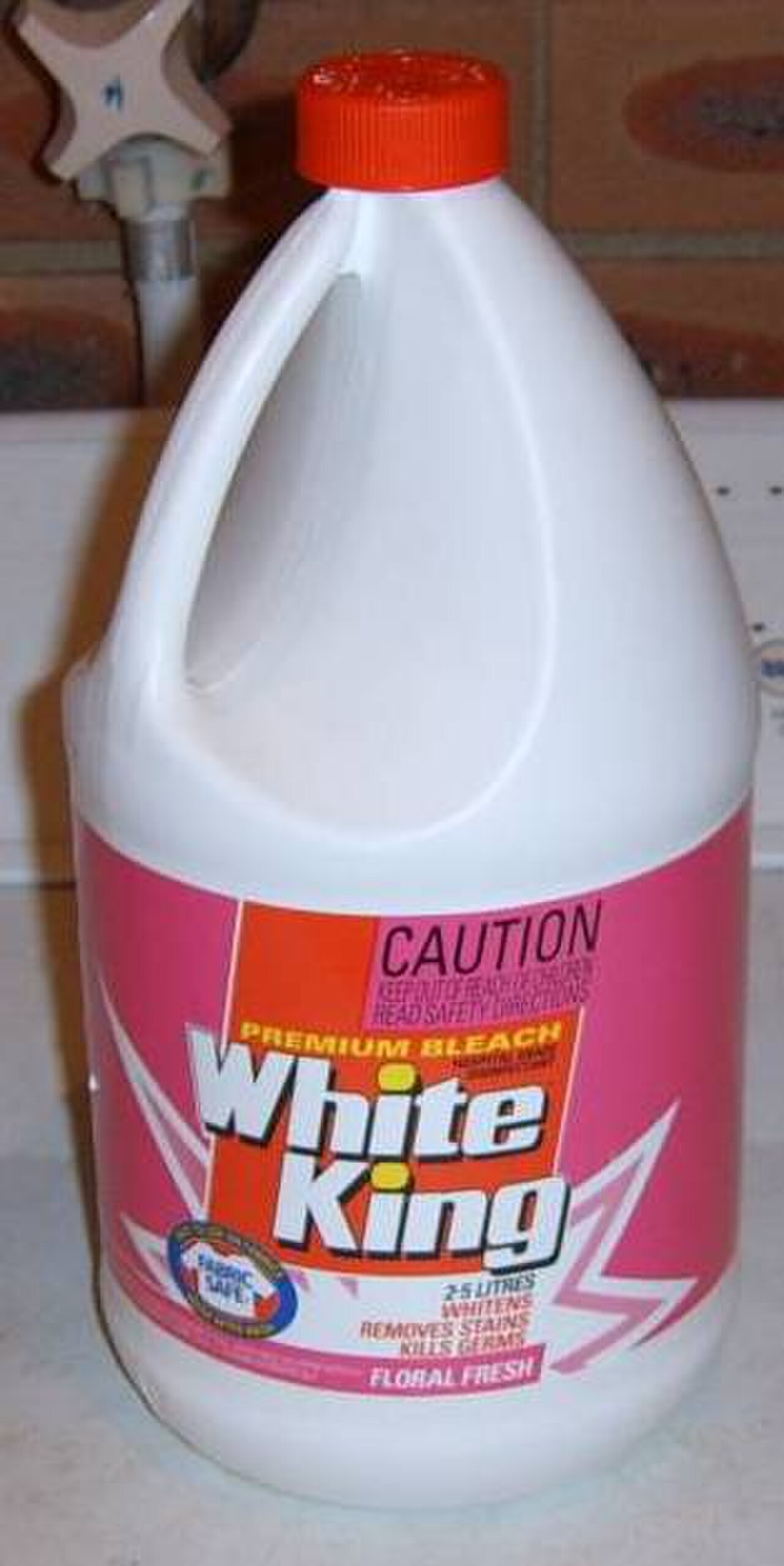
Bleach bottle by MarkGallagher, Wikimedia Commons, CC BY-SA 2.5

Here's a combination of facts most homeowners don't know:
- Trash cans almost always contain ammonia residue (from pet waste, diapers, old food).
- Bleach reacts with ammonia to create chloramine gas.
- Chloramine gas is toxic.
- This reaction happens in confined spaces like... closed trash cans.
The conclusion: pouring bleach into a bin with ammonia residue and closing the lid is one of the most common toxic-gas-exposure mistakes homeowners make. It's not hypothetical. People get hospitalized for this every year.
This article covers what bleach actually does, when it's the wrong tool, and what to use instead.
Don’t pour bleach in there. Let the Bros clean it.
200°F water. No soap, no chemicals, pet-safe. We come to your curb and haul the funk away.
Book in 60 seconds — 50% off with FIRST50 →What bleach is (and what it does)
Household bleach is sodium hypochlorite (NaOCl) diluted in water. It's a powerful oxidizer — it breaks chemical bonds by attacking electrons.
What this means practically:
- It kills bacteria and viruses very effectively
- It lightens and removes color (bleaching effect)
- It breaks down organic matter on contact
Bleach is a legitimate cleaning tool for:
- Hard surfaces like tile, grout, and sinks
- Laundry whitening
- Mold removal (in ventilated areas)
- Pool and spa sanitization (at proper dilution)
Where it falls apart: places with mixed chemical environments, like trash cans.
The ammonia reaction
When bleach meets ammonia or ammonia-based compounds, the chemical reaction produces chloramine gas (various combinations of nitrogen and chlorine, most commonly NH2Cl).
Chloramine exposure symptoms:
- Immediate: coughing, chest pain, shortness of breath
- Short-term: eye, nose, and throat irritation
- Heavier exposure: pulmonary edema, in severe cases fatal
The gas is heavier than air, which means it concentrates in enclosed spaces — exactly the inside of a closed trash bin.
Where ammonia comes from in residential bins
Everything on this list contains ammonia or breaks down into ammonia:
- Urine (human, dog, cat, any mammal)
- Baby diapers
- Cat litter
- Decaying meat (protein breakdown produces ammonia)
- Dairy products gone bad
- Dead animals (occasional raccoon or mouse in bin)
- Some cleaning products you might have already sprayed in there
- Windex (contains ammonia)
In a typical residential bin that hasn't been cleaned in a few months, multiple sources of ammonia are present. Pouring bleach in is not "cleaning" — it's creating chemical reactions with unknown results.
The "but I rinse first" counter-argument
Common response: "I rinse the bin first, then use bleach, so there's no ammonia."
Three problems:
-
Rinsing doesn't fully remove ammonia residue. Dried urine, stuck-on meat juice, and diaper residue survive a hose rinse. The ammonia isn't in the visible liquid — it's in the dried residue that cold water doesn't lift.
-
Residue in cracks and seams. Plastic bins have microfractures, lid seal lines, and hinges where residue accumulates. A surface rinse doesn't clean any of these.
-
Previous cleaning products. If you or a previous owner ever sprayed an ammonia-based cleaner in the bin, residue remains. Same for Windex, some floor cleaners, and many "all-purpose" products.
The safe assumption: your bin has ammonia residue somewhere. Don't add bleach to it.
Real cases
This isn't theoretical. Poison control centers receive thousands of chloramine-exposure calls per year in the US alone. A 2016 study (published in Journal of Emergency Medicine) documented 6,300+ cases in a year, with most in residential settings involving cleaning.
The common thread in the residential cases: someone mixed products to "clean better," or added bleach to something already containing ammonia (cat litter boxes, diaper pails, trash cans). Many cases resulted in hospitalization. A smaller number resulted in death.
This is not a "read the label" precaution. This is a real home-chemistry risk.
What to use instead for trash cans
You have options that work without chemical risk.
Best: Hot water + pressure
Heat above 160°F kills bacteria on contact. Pressure removes residue mechanically. No chemicals needed for the disinfection step.
This is what our professional cleaning uses — 200°F water at 3,500 PSI. The heat sanitizes, the pressure cleans, and there's no bleach, ammonia, or any other reactive product involved.
For DIY: boiling water poured over stuck areas, plus a pressure washer if you own one. Cold-water pressure washers don't sanitize the same way — the physical removal helps but doesn't kill bacteria.
Good: White vinegar
Distilled white vinegar is mildly acidic (pH around 2.5). It kills fly eggs, disrupts bacterial colonies, and helps dissolve mineral deposits.
How to use:
- Fill a spray bottle with undiluted or 1:1 diluted vinegar
- Spray the interior thoroughly
- Let sit 10 minutes
- Rinse with hot water
- Dry completely
Downsides:
- Strong smell while working (harmless, but unpleasant)
- Less aggressive than bleach on heavy stuck-on material
- Doesn't kill 100% of pathogens (but handles the common ones)
Good: Hydrogen peroxide (3% drugstore strength)
Breaks down into water and oxygen. Safe around pets, kids, and plants. Kills most bacteria and some viruses.
How to use:
- Spray undiluted
- Let sit 5-10 minutes
- Rinse
- Dry
Downsides:
- Weaker than bleach for severe contamination
- Less effective on dried protein residue (works better after physical cleaning)
Good: Commercial pet-safe disinfectants
Products like Rescue, Simple Green D Pro 5, and Seventh Generation Disinfecting are formulated to be effective without toxic chemical risk.
Read labels for compatibility before using on plastic bins.
Avoid: Pine-Sol concentrate
Contains phenol. Not as dangerous as bleach-ammonia reactions, but prolonged exposure is toxic. Use the diluted formulation only if at all, and consider alternatives.
Avoid: "All-purpose" cleaners of unknown composition
Many brand-name cleaners contain ammonia or bleach without obvious labeling. If you can't identify the active ingredients, don't use it in a bin.
When bleach is actually fine
There are narrow cases where bleach works for bin cleaning:
- You're certain the bin is completely dry and has been thoroughly washed with water first
- No prior ammonia-based product has been used in the bin
- You're working outdoors with excellent ventilation
- You're applying dilute bleach (not concentrated) and rinsing immediately
Even then, the safer alternatives above work just as well without the chemical gamble. Most professional bin cleaning services don't use bleach at all.
The pet angle
If you have dogs or cats, there's another reason to avoid bleach in the bin:
- Dogs sniff bins — residual bleach on the exterior can damage their nasal passages
- Cats walk past bins and lick their paws — bleach residue is toxic to cats at low doses
- Liquid runoff from bleach-cleaned bins kills grass and is toxic if your pet drinks from puddles
Our pet safety guide covers the full picture, but short version: professional cleaning uses 200°F hot water and a pet-safe deodorizer with natural essential oils — no soap, safe around pets, safe for lawns, safe for groundwater.
The real misconception
Most homeowners use bleach on trash cans because it "kills germs." That's true — bleach does kill germs. But:
- Bleach doesn't remove stuck-on organic material (the food for germs to grow back)
- Bleach doesn't penetrate cracks where germ colonies live
- Bleach reacts with the stuff already in the bin in ways that create real risk
The better model: physically remove residue first (hot water + pressure), then disinfect with something safer (vinegar, peroxide, or commercial pet-safe cleaner). Cleaning and disinfecting are two separate steps, and bleach skips the cleaning step while amplifying the risk.
What to do this week
If you've been using bleach on your bins:
- Stop. The risk is real.
- Next time, do a hot-water rinse + vinegar spray instead. Or skip the DIY entirely.
- For the buildup you've been trying to address with bleach, a single professional deep clean usually handles it. $37.50 with code
FIRST50— half off the $75 one-time rate.
Bleach is a useful product for specific surfaces. Trash cans aren't one of them. The combination of hidden ammonia residue, enclosed space, and bleach's reactivity turns a cleaning task into a chemistry experiment with real consequences.
Related reading: Why trash cans smell like ammonia (the source of the problem), Maggots in your garbage can, Is your dirty trash can making your dog sick?, and Pregnancy and cleaning bins.
Don’t pour bleach in there. Let the Bros clean it.
200°F water. No chemicals. Pet-safe. No contracts. Code FIRST50 takes 50% off your first clean.