Coyotes Near Your Trash Bins in the KC Northland
June 30, 2026 · Bin Bros KC Team
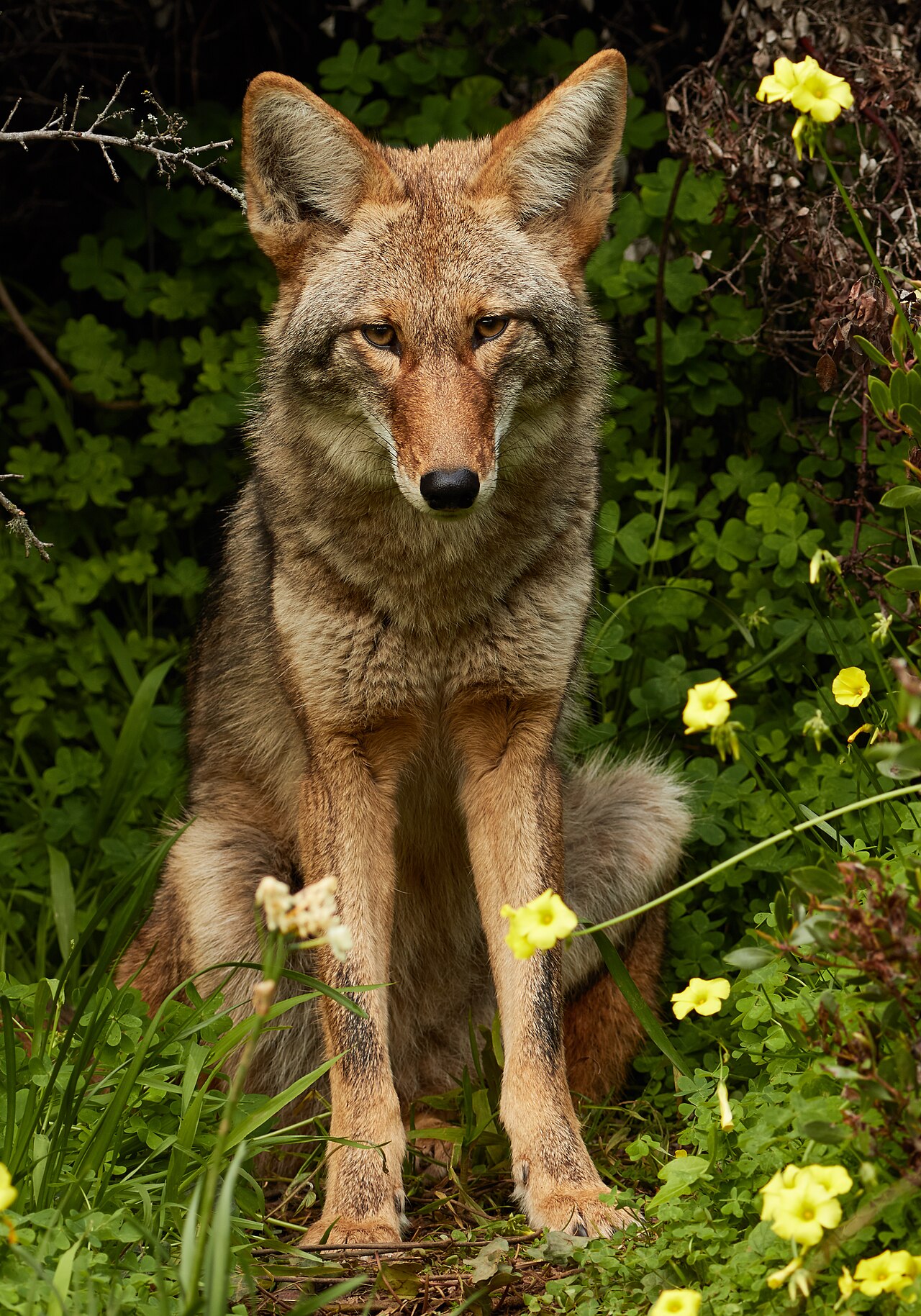
An urban coyote standing on a residential street at dusk by Frank Schulenburg, Wikimedia Commons, CC BY-SA 4.0

A neighbor near Shoal Creek sent us a Ring clip last spring: a coyote trotting up her driveway at 5:40 a.m., pausing at the trash cans by the garage, then moving on. She wanted to know if the bins were what brought it in. The honest answer is yes and no, and the difference matters if you want it to stop.
Coyotes are not raccoons. They almost never open a bin, dig through a bag, or scatter trash across the lawn. But your trash still plays a role in why they walk your street at all. The link is one step removed, and once you see it, the fixes get a lot more obvious.
Wildlife working your bins over? Let the Bros clean it.
200°F water. No soap, no chemicals, pet-safe. We come to your curb and haul the funk away.
Book in 60 seconds — 50% off with FIRST50 →Coyotes live in every Northland neighborhood now
This is not a rural-edge problem anymore. The Missouri Department of Conservation reports coyotes in all 114 counties, including dense suburbs and the middle of Kansas City itself. They have adapted to people about as well as any wild animal in North America.
In the Northland, the geography helps them. Line Creek, Shoal Creek, Rush Creek, and the Missouri River bottoms form green corridors that run right through neighborhoods. Hodge Park, Tiffany Springs, the trails around Smithville Lake, and the wooded draws behind newer subdivisions give coyotes cover, water, and travel routes. A coyote can move from Hodge Park to a cul-de-sac in Staley Farms without ever crossing much open ground.
The Cook County Urban Coyote Project, a long-running study of suburban coyotes near Chicago, found that urban coyotes mostly avoid people and keep to a predictable home range. That holds here too. The coyote on your camera is probably a local that has been around longer than you think, not a one-time wanderer.
What your trash actually has to do with it
Here is the part most homeowners miss. Coyotes are drawn to your property by a food chain, and your trash sits near the bottom of it.
The bin itself is rarely the target
A coyote can smell the food residue baked into a dirty bin. It usually will not work to get inside the way a raccoon does, because coyotes are built to hunt and scavenge in the open, not to manipulate latches. So the bin is not the meal. It is the sign that says a meal might be nearby.
Rodents are the real draw
A trash can that smells like food attracts rats and mice. Rats and mice attract coyotes. Roughly speaking, a coyote's diet leans heavily on small rodents, rabbits, and fruit, with garbage as an opportunistic add-on. If your bins are feeding a rodent population, you are stocking a coyote's pantry without ever seeing the middle step.
This is why a rat problem and a coyote sighting often show up on the same block within a few weeks. If you have noticed the early signs, our guide on reading the signs of rats around your trash covers what to watch for before the population grows.
Pet food and fallen fruit finish the picture
The other big attractants sit right next to the bins for a lot of Northland homes:
- Dog or cat food left on the patio overnight
- Fallen fruit under a tree or unsecured compost
- Bird seed spilled under a feeder
- Water bowls left out in summer
Clear those, keep the bins from feeding rodents, and you remove most of what makes a coyote slow down at your house instead of passing through.
Are coyotes dangerous to you, your kids, and your pets?
This is the question that actually keeps people up at night, so let's be straight about the levels of risk.
To people
Very low. Coyote attacks on adults are rare across the entire country. The animal's default around humans is avoidance. The exceptions almost always trace back to coyotes that got fed by people, on purpose or by accident, and lost their natural wariness. A coyote that learns humans mean food is the one that becomes a problem, which is the strongest reason not to leave anything edible out.
Small children should not be left unsupervised in a yard where coyotes are active, the same as any wildlife. That is caution, not panic.
To dogs and cats
This is the real concern. Coyotes see small dogs and outdoor cats as competition or prey, especially during pup-rearing season in spring. The risk is highest for:
- Cats allowed outdoors, particularly at night
- Small dogs (under about 25 pounds) let out alone after dark
- Any dog left unattended in an unfenced yard at dawn or dusk
Practical protection is simple. Keep cats indoors. Walk dogs on a leash, not a retractable one, near creek corridors and parks. Go outside with small dogs for the last yard break of the night, and turn on a light first. A six-foot privacy fence helps, though a determined coyote can clear or dig under a shorter one.
If a coyote and your dog have crossed paths, it is also worth knowing what a contaminated yard or bin can pass along. Our piece on whether a dirty trash can is bad for your dog gets into the bacteria side of that.
What actually keeps coyotes off your property
In rough order of effectiveness for a typical Northland yard:
- Cut the food chain. Keep bins clean enough that they stop feeding rodents, bring pet food in, and clear fallen fruit and seed. This is the root fix, and it is the one most people skip.
- Haze, don't ignore. If you see a coyote in your yard, make yourself big and loud. Wave your arms, shout, bang a pot, throw a tennis ball in its direction. The goal is to keep coyotes afraid of people. A coyote you quietly watch from the window is learning your yard is safe.
- Light the approach. Motion-activated floodlights near the bins and along the side yard make a coyote feel exposed. LED fixtures run $25 to $40 at any hardware store.
- Secure the perimeter at night. Close gates, store pet food inside, and pick up dog waste, which coyotes will also investigate.
- Leash and supervise pets near the creek trails and at dawn and dusk, the two windows of peak coyote movement.
Things that do not work, despite the marketing: ultrasonic repellers, mothballs, and predator-urine sprays in an open yard. Coyotes habituate fast or simply ignore them.
When Northland coyote activity spikes
Two windows account for most of the sightings we hear about.
Late winter into spring (roughly January through May). Coyotes mate in January and February and raise pups in April and May. Parents range farther and defend territory harder, which is when most dog conflicts happen. If you have a small dog, this is the season to be most careful.
Fall (September through November). Young coyotes disperse to find their own territory, so you get more unfamiliar animals moving through and showing up on cameras in places they had not been before.
Activity also climbs in any season when the rodent population around the bins climbs, which loops right back to the trash.
Where Northland coyote reports cluster
Based on what customers tell us, the heaviest sighting reports come from homes backing up to green space:
- Shoal Creek and Hodge Park (64157) — heavy creek and parkland cover
- Parkville (64152) — Riss Lake, English Landing, and the bluff draws
- Gladstone near Happy Rock Park (64118)
- Liberty along the wooded edges near Brooke Hills and the Belt
- Kearney and Smithville (64060, 64089) — rural margins and lake corridors
Newer interior lots with little tree cover report fewer coyotes, the same pattern we see with raccoons. If your yard touches a creek, a trail, or a wood line, assume coyotes pass through and plan accordingly.
Frequently asked questions
Will coyotes get into my trash can? Rarely. Coyotes are not built to open lids the way raccoons are. They are drawn to the area around the bins by food smells and by the rodents those smells attract, not by the trash itself.
Should I be scared if I see a coyote in my yard? No, but do not ignore it. Make noise and look threatening so it keeps its fear of people. A coyote that gets comfortable around homes is the one that eventually causes trouble.
What time of day are coyotes most active in the Northland? Dawn and dusk are peak movement windows, though urban coyotes also move at night. Daytime sightings are normal and do not by themselves mean the animal is sick.
How do I protect my small dog or cat? Keep cats indoors, walk dogs on a fixed leash, supervise small dogs in the yard at night, and turn on a light before letting them out near creek corridors.
Does keeping my bins clean really make a difference? Indirectly, yes. Clean bins do not feed rodents, and fewer rodents means less reason for a coyote to hunt your block. It removes a link in the chain that draws them in.
What to do this week
If coyotes have started showing up near your home:
- Bring pet food and water bowls inside tonight. Fastest single change you can make.
- Book a deep clean so the bins stop feeding the rodents that feed the coyotes. Code
FIRST50gets your first clean at half off. Sign up here. - Add a motion light near the bins and side yard within the week.
Related reading: Raccoons in your trash: Northland deterrents, Opossums in the garbage: are they harmful?, Signs of rats in your Northland trash, and the KC Northland trash day map for pickup schedules across the area.
Wildlife working your bins over? Let the Bros clean it.
200°F water. No chemicals. Pet-safe. No contracts. Code FIRST50 takes 50% off your first clean.