Halloween Pumpkin Rot: What to Do With a Collapsed Jack-o'-Lantern
September 3, 2026 · Bin Bros KC Team
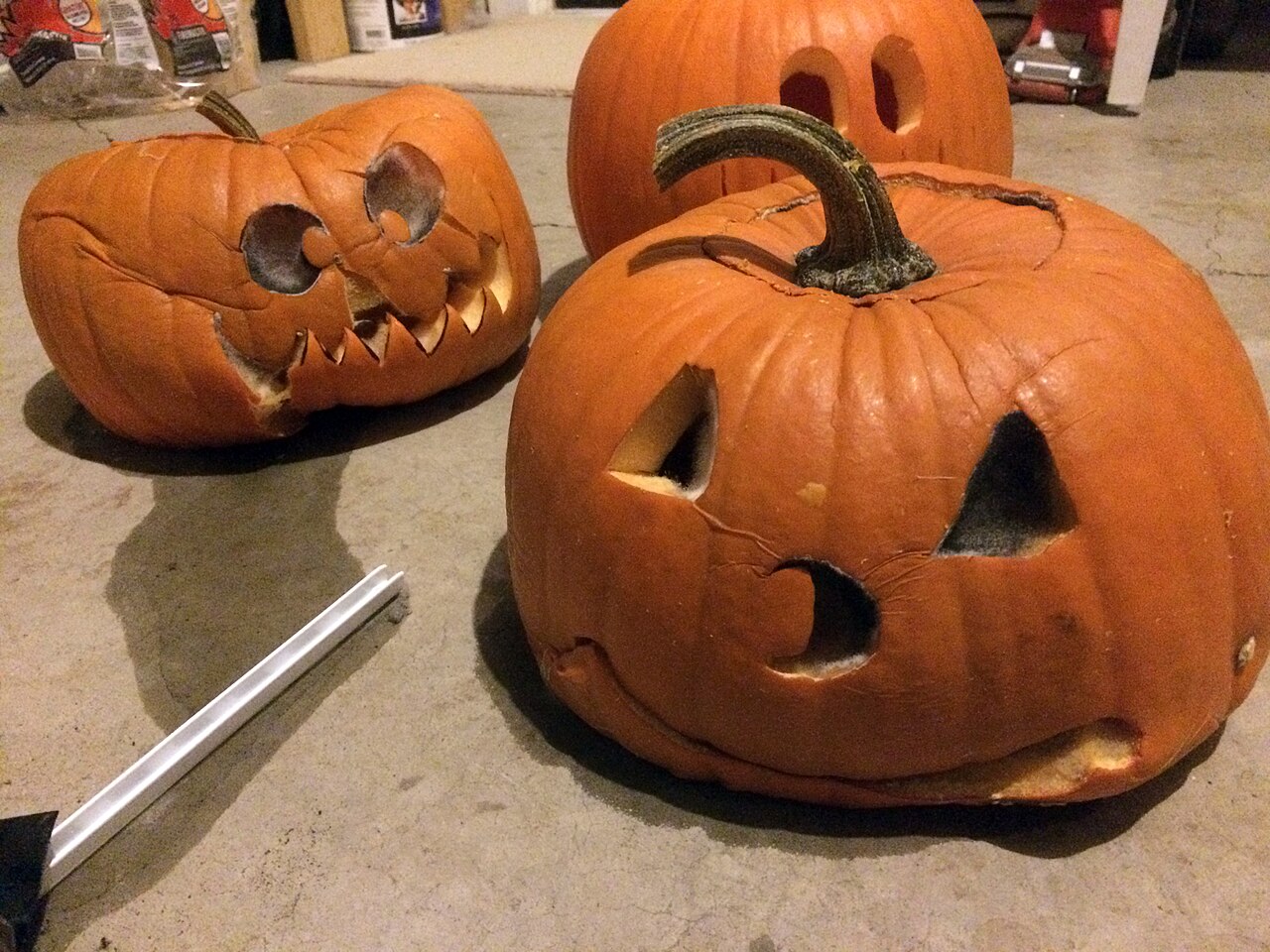
When Pumpkins Rot by daryl_mitchell from Saskatoon, Saskatchewan, Canada, Wikimedia Commons, CC BY-SA 2.0
.jpg)
The pumpkin on the porch looks fine on Halloween night. It looks fine on November 1. Somewhere around November 3 a homeowner goes out to move it and their fingers go straight through the side of it, and what comes off the porch board is not a pumpkin anymore.
That collapse is not bad luck and it is not a bad pumpkin. It happens on close to the same date every year in the Northland, for a reason you can read off a weather chart.
Pumpkin slime welded to the floor of your cart? Let the Bros clean it.
200°F water. No soap, no chemicals, pet-safe. We come to your curb and haul the funk away.
Book in 60 seconds — 50% off with FIRST50 →Why the jack-o'-lantern gives out the first week of November
Two numbers explain almost all of it.
The first is what a pumpkin is made of. USDA FoodData Central puts raw pumpkin at 91.6% water. A 20-pound pumpkin on your steps is carrying a little over 18 pounds of water, which is about two and a quarter gallons.
The second is the calendar. National Weather Service records for Kansas City, going back to 1888, put the average first fall freeze at October 28. Three days before Halloween. The normal high slides from 74°F on October 1 to 61°F on October 31, and the overnight lows do the real work.
Water expands when it freezes. In a pumpkin, that expansion ruptures the cell walls holding the flesh together. The pumpkin still looks normal while it is frozen. Then the afternoon warms up, it thaws, and the structure that was holding two gallons of liquid in a pumpkin shape is gone.
Carving accelerates all of it. An uncarved pumpkin has an intact rind doing what a rind does. A carved one has open cut faces that mold and bacteria reach on day one, which is why a jack-o'-lantern carved the weekend before Halloween is usually already soft by the time it comes off the porch.
What a collapsed pumpkin does inside a 96-gallon cart
Most people carry the thing out at arm's length, drop it in the cart, and consider it handled. Then trash day is four days out.
Two and a quarter gallons of sugary liquid has to go somewhere, and the cart is a sealed plastic box sitting in the sun. The liquid runs to the bottom, finds the scuffs and gouges in the cart floor, and sits in them. A garden hose cannot reach into a scratch, which is the whole reason the smell outlives a rinse. We went through that chemistry in why trash cans smell like ammonia.
There is a second-order problem specific to November. If the pumpkin liquid pools and then the temperature drops again, it freezes to the floor of the cart. Now you have a sheet of pumpkin ice bonded to the plastic, and the truck's tipper will not shake it out. It rides in your cart until something melts it. That is the same category of problem as the frozen and baked-on residue we get called about all winter.
The wildlife timing is bad
Late October and November is when raccoons and opossums are packing on fat for winter. A soft, high-sugar, easy-to-open food source in an unlatched cart is about the best thing that happens to a raccoon all season.
Our crew sees the pattern on the same streets every year — cul-de-sacs backing to timber off NE Barry Road, the wooded lots along Shoal Creek, the greenbelt edges in Riss Lake. A pumpkin in the cart the week of November 1 turns a cart that had never been touched into one that gets worked over three nights running. The prevention playbook is the same one in raccoons in Northland trash: latch it, weight it, and do not give them a reason to check.
The candy half of the problem
Wrappers are the opposite problem from the pumpkin, and they get handled as though they were the same one.
A fun-size wrapper is dry, inert, and does not smell. It is also metallized multilayer film, which is why no Northland curbside stream takes it for recycling. It belongs in the trash cart, and nobody needs to feel bad about that. The trouble it causes is physical rather than bacterial, and it shows up two ways.
- They travel. A few hundred wrappers loose on top of a cart, a lid that will not latch over a full load, and one 30 mph November gust is how a cul-de-sac off NW 64th Street in Parkville ends up picking wrappers out of five yards. Bag them, tie the bag, and put something heavier on top.
- They arrive with chocolate still attached. A cart a raccoon has opened leaves candy scattered on the driveway, and the dog finds it before anyone else does. Chocolate and the xylitol in sugar-free candy are both a real vet call, and the risk a dirty cart poses to a dog climbs the week after Halloween.
Can you put a pumpkin in your Northland trash cart?
Yes. This is the part people get wrong in the other direction.
Missouri banned yard waste from landfills on January 1, 1992, under state statute 260.250, which is why bagged leaves keep getting left at the curb every fall. We covered that rule in the fall leaf and yard waste guide. A pumpkin is not yard waste. It is food waste, and food waste is ordinary household trash. Your hauler will take it.
Legal and best are different questions, though. A pumpkin in the cart is two gallons of liquid you have to clean up after. A pumpkin in the compost stream is not.
Where to compost a pumpkin in the KC Northland
There are two real options north of the river.
- Missouri Organic Recycling, Northland yard — 11660 N. Main Street, Kansas City, MO 64155. Open 8 a.m. to 5 p.m. Monday through Saturday, closed Sundays. Kansas City, MO residents drop off free on Saturdays with a KCMO ID or a current utility bill showing a KCMO address. That covers the Northland ZIPs from Briarcliff up through Shoal Creek. It does not cover the cities of Gladstone, Liberty, Parkville, Smithville, or Kearney, whose residents pay the standard rate.
- KC Can Compost, Briarcliff drop-off — the Carne Diem site at 4179 N Mulberry Dr, 64116, which is the one Northland location on their map and a reasonable stop for anyone already coming down N Oak Trafficway.
If you garden, the simplest option is your own yard. Break the pumpkin apart, pull the seeds if you do not want volunteers next June, and bury the pieces in a bed. Nine tenths of it is water, so it disappears fast.
One rule for all three: painted, glittered, or waxed pumpkins do not go in compost. Neither do the plastic inserts, tea light cups, or battery candles. Those go in the cart. Sort them out before you load the car.
How do you get rotten pumpkin out of a trash can?
If it already collapsed in there, the order matters.
- Do it the morning after pickup, when the cart is empty. Twenty minutes on an empty cart against an hour of fighting a half-full one. Check your street's day on the trash day map if you are new to the neighborhood.
- Scoop the solids first, dry. A flat-bladed shovel or a dustpan you are willing to lose. Sending two gallons of pumpkin down the driveway is how it ends up in a storm drain, and pumpkin pulp in a storm inlet is somebody's problem downstream.
- Hot water, not cold. Cold water spreads the film around. A kettle or a stockpot of near-boiling water poured along the cart floor breaks the sugar bond that cold water slides over. This is the whole reason our trucks carry 200°F water instead of a pressure washer.
- Scrub the corners and the wheel-well ridges. That is where the liquid settles and where the smell lives after the flat panels look clean.
- Dry it open, upside down, in the sun. A closed damp cart in a 55°F garage is how you get the gray film in the corners by December.
What to do this week
October is not here yet, which is exactly why this is worth reading now.
- Carve late. A pumpkin carved the Wednesday before Halloween holds through trick-or-treat. One carved two weekends early is soft before anybody sees it.
- Set a November 1 reminder to move it off the porch. The freeze that ends it is due October 28 on average. Waiting for the collapse to tell you it is time is waiting three days too long.
- Pick the compost stop now, not on the drive. Missouri Organic's Northland yard on N. Main is open Saturdays and free for KCMO addresses. Pull the tea lights and skip it entirely if the pumpkin is painted.
- If it goes in the cart, get the cart cleaned after that pickup. Two gallons of sugar water in the bottom of a cart heading into winter is the setup for everything we get called about in March. First clean is $37.50 with code
FIRST50, half off the $75 one-time rate — or quarterly service runs $15 a month ($22.50 first clean with the same code). Sign up here. We work at the curb, so nobody needs to be home.
Pumpkin slime welded to the floor of your cart? Let the Bros clean it.
200°F water. No chemicals. Pet-safe. No contracts. Code FIRST50 takes 50% off your first clean.