Storm Prep for KC Trash Bins: Stop Them Blowing Away
May 12, 2026 · Bin Bros KC Team
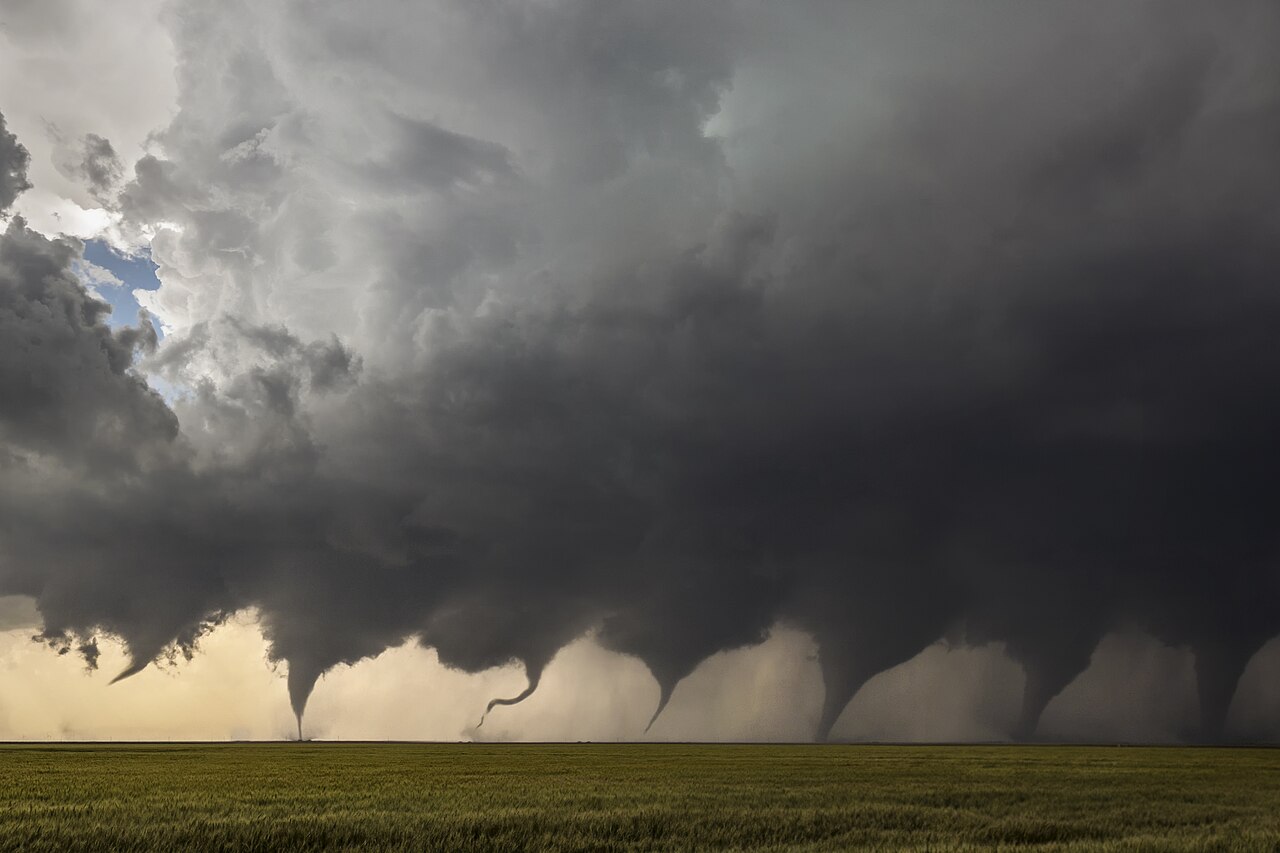
Composite photo of a tornado forming on the Kansas plains by JasonWeingart, Wikimedia Commons, CC BY-SA 4.0

Last May, one of our Liberty customers off NE 152nd called us about a bin that had vanished. We figured it had been knocked into the ditch by the GFL truck. Two days later, her neighbor on NE 158th found it in his back yard. The lid was a quarter mile away on Pleasant Valley Road, cracked clean through.
That kind of thing happens here every spring. Greater Kansas City sits at the eastern edge of Tornado Alley, and Clay and Platte counties have logged severe-thunderstorm warnings on roughly 35 days a year for the past decade, per the National Weather Service's Pleasant Hill office. Most of those storms produce straight-line winds in the 50-70 mph range. A small percentage pump out gusts above 80 mph or spawn brief EF0-EF1 tornadoes.
An empty 64-gallon polycart weighs about 30 pounds. It starts sliding around 35 mph and starts flying around 55 mph. That's a number worth remembering. The wind threshold for an ordinary trash bin to become a projectile is well below the threshold for the storm itself to look scary.
This guide is what we tell customers when they ask how to keep their bins from disappearing during storm season — roughly mid-March through the end of June in the Northland, with a smaller second peak in October.
Storm dumped your bin across the yard? Let the Bros clean it.
200°F water. No soap, no chemicals, pet-safe. We come to your curb and haul the funk away.
Book in 60 seconds — 50% off with FIRST50 →Why KC Northland bins are unusually vulnerable
Three things compound here that don't compound everywhere else:
Open lots and corner curbs. A lot of the newer Northland subdivisions — Staley Farms, Walnut Creek, Liberty Hills, Hidden Valley off Highway 152 — have wide setbacks and treeless front yards by design. Pretty in spring. Wind tunnels in May. A bin parked at the curb has nothing between it and a straight-line gust rolling out of Platte County.
Two bins per house in most service areas. GFL gives Liberty residents one trash and one recycling cart. Gladstone uses Red Nose Service, Smithville uses WastePro, and many Parkville neighborhoods are on private subscription. Either way, that's two 60-pound projectiles when full, two 30-pound projectiles when empty.
Storm timing matches pickup day for half the Northland. Kearney's Tuesday pickup, Smithville's Wednesday pickup, and Liberty's Friday split route all overlap with the days the Storm Prediction Center most often flags Northwest Missouri for severe weather. Bins out at the curb during a watch is a normal Wednesday afternoon here.
Where to store the bin during a watch or warning
Priority order — pick the highest one that's actually available to you.
1. Inside the garage
The single safest place. Even one extra layer of wall between the bin and 80 mph winds makes the difference between "irritating to find" and "I'm calling the insurance company about the siding."
If your garage is full of other stuff, this is the week to clear two square feet for storm season. A 64-gallon polycart footprint is 24" x 28". You'll get it back in July.
2. Against a brick or stone exterior wall, lid strapped down
Second best. The wall blocks wind on one side, and a bungee cord or ratchet strap looped over the bin and tied to a downspout bracket or stair railing keeps the lid from opening and acting as a sail.
Critical detail: the strap has to come down over the closed lid, not just around the bin body. An open lid in 60 mph wind is the failure point — it catches air, lifts the whole bin, and now you've got a bin sliding across the lawn with a strap dragging behind it.
3. Inside a fenced backyard, lid against the fence
Third best if the garage and exterior wall aren't options. The fence breaks some of the wind, and even if the bin tips, it can't travel far.
Don't do this if your fence is privacy panels in marginal shape. A 30-pound bin slamming into an aging fence panel during a microburst is a fence repair you didn't budget for.
4. Tipped on its side in a corner
Last resort. A bin lying on its side has less surface area facing the wind and a lower center of gravity. It's not great, but it's better than upright in the middle of an open driveway.
Anchoring methods that actually work
If the bin has to stay outside upright — say, because the storm hit between pickup time and when you got home from work — these are the methods we've seen hold:
Bungee cord between two fixed points. Run a heavy-duty bungee from a downspout bracket, fence post, or deck railing over the top of the closed lid and back to another anchor point. Tightens with wind load. About $8 at the Liberty Lowe's.
Ratchet strap over the lid, looped under the bottom rim. More secure than a bungee but slower to attach and release. Good for overnight storms when you won't need to access the bin.
Bin enclosure with a built-in lid latch. The wood or composite enclosures sold for HOA-strict neighborhoods (we cover HOA bin rules in the Northland here) usually have a latching lid that solves the projectile problem as a side effect. Common in Staley Farms and the Stonebridge neighborhoods.
Water weight in the bin itself. Counterintuitive but it works. A bin half-full of water weighs 250+ pounds. It won't fly. Empty it after the storm passes. This is only useful when the bin is empty of trash to begin with and you have several hours of warning — i.e. a watch, not a warning.
What not to do (we see these every year)
Cinder block on top of the lid. The block stays. The bin and lid leave separately. Then the block falls off the upended lid and cracks something. We've seen this break a windshield in Smithville.
Tying the bin to a small tree. The bin survives. The tree doesn't. Or both leave together.
Setting it inside the open garage during the storm. If garage doors fail at 70-90 mph, an unsecured bin inside an open garage becomes a much bigger interior problem than a bin on the lawn.
Trusting the bin's own weight when full. A full bin weighs 60-90 pounds. A 70 mph gust generates about 130 pounds of force on a 24-square-inch vertical surface. The math doesn't favor you.
Storm timing — when to bring the bin in
The National Weather Service issues two relevant alerts:
- Severe Thunderstorm Watch. Conditions are right for damaging storms in the next several hours. This is your cue to move the bin if it's outside and you have time.
- Severe Thunderstorm Warning or Tornado Warning. A storm is happening or imminent. Move the bin now if it's safe to step outside. If not, leave it. A replacement bin is $80-150 depending on hauler. A trip to the ER costs more.
Pickup day complication: if the storm is forecast for the evening of your pickup day and your bin is already out at the curb, bring it back to the house as soon as you get the watch alert. Don't wait until you see the wall cloud. Visit our Liberty trash schedule guide or any of our city trash-day guides to confirm your specific pickup window so you know how long the bin needs to be outside.
After the storm — the five-minute check
Once the warning expires:
- Find both bins. Walk the property line. Check the alley if you have one. In a serious storm, check across the street.
- Inspect the lid hinge and the body. Cracks at the rim or stress fractures from impact mean the bin is on borrowed time and should be replaced before next pickup.
- Rinse out anything that got into the bin during the storm. Wet leaves, broken branches, neighbors' wrappers, mulch. All of it accelerates bacterial growth — see our bacteria buildup guide for why that matters more than you'd think.
- Re-anchor before the next system. Spring storms in KC come in waves. The week of May 6, 2024, the Pleasant Hill NWS office issued severe-thunderstorm warnings on four different days. One prep job that lasts the whole week is cheaper than re-doing it after each round.
- Report a missing bin to your hauler. GFL, Republic, WastePro, and Red Nose all have replacement processes. Some charge, some don't. Most replace within 5-10 business days.
A note on missing-bin replacement costs
Replacement fees as of last quarter for the haulers serving the Northland:
- GFL — $75 to $90 depending on size, billed on the next monthly statement
- Republic Services — $50 to $100, varies by contract type
- WastePro (Smithville) — typically free for the first replacement, $60 after
- Red Nose Service (Gladstone private subscribers) — $45 to $75
Insurance generally doesn't cover a missing trash bin unless it caused damage to your own property — and even then, the deductible usually exceeds the bin replacement cost. The exception is if a flying bin damaged a neighbor's car or house; in that case, your homeowner liability might come into play, depending on whether you'd taken "reasonable precautions." Anchoring matters for that conversation.
The Bin Bros KC angle
We get more service-pause requests in May than any other month — usually phrased as "we lost our bin in the storm, can we pause until the replacement gets here." We don't charge a pause fee for that. We do recommend setting up the replacement bin with a strap, bungee, or enclosure before the next system rolls through, because losing two bins in one season is a frustration we'd rather customers avoid.
If the storm-damaged bin is recovered but the inside looks rough — rain-soaked old food, debris, mystery fluids from sitting open in a flooded yard — that's worth a clean before summer hits in earnest. Our quarterly service covers it.
Want both bins cleaned before the heat sets in?
Code FIRST50 gets your first clean at half price. Quarterly service is $15/mo. No contracts, no equipment to buy, and we work around your pickup day so the bin is ready when the truck comes. Sign up here.
Related reading: Why trash cans smell like ammonia, Spring cleaning the trash can in KC, Summer maggot prevention for Missouri humidity, and our KC Northland trash-day map covering all 21 service ZIPs.
Storm dumped your bin across the yard? Let the Bros clean it.
200°F water. No chemicals. Pet-safe. No contracts. Code FIRST50 takes 50% off your first clean.